Duolingo English Test (DET) Result Sample Explained
Reading a real scorecard: the 10 to 160 overall score, individual and integrated subscores, why there are two subscore sections, and result validity.

Lume Test
|
Jan 24, 2026
•
5 min read
Key Takeaways
- Reading a real scorecard: the 10 to 160 overall score, individual and integrated subscores, why there are two subscore sections, and result validity.
Don’t just look at the overall score when you receive the Duolingo English Test (DET) result!
It cannot tell the whole story about your language proficiency.
Instead, examine other subscores to identify which skills need more practice.
But since there are multiple score elements, many test-takers don’t know how to read it.
Worry not!
LUME will give you a Duolingo English Test (DET) result sample in this guide.
Then, you can understand the scorecard to the fullest, from the overall score to every subscore.
|
Want to ACE the Duolingo English Test (DET) And Reach Your Goals? Get Your FREE Lume Account Today to Unlock… ✅ 10,000+ PRACTICE QUESTIONS with detailed answers ✅ FREE MOCK TESTS with fast & accurate AI scoring ✅ Get BETTER SCORES with a PERSONALIZED study plan (Limited seats available!) |
Key Takeaways
- The Duolingo English Test (DET) certificate typically includes four main elements: personal information, the overall score, the individual subscores, and the integrated subscores.
- The overall score ranges from 10 to 160, giving you an overview of your language proficiency.
- The individual subscores show your performance in four main skills.
- The integrated subscores reflect your ability to use combined skills.
Why Should You Understand The Duolingo English Test (DET) Result?
Examining the Duolingo English Test (DET) scorecard, from the overall score to subscores, can benefit you in many ways:
- Interpreting subscores helps you identify areas for improvement.
When knowing your weak skills, you can create a more effective practice plan to get a higher score on the next try.
- Each university/college has its own minimum requirements.
Comparing your subscores with their standards informs you which institute suits you the most.
You can have a higher acceptance rate if applying to those universities.
- Comparing your Duolingo English Test (DET) scores to other popular tests like IELTS or TOEFL is also helpful.
If you think your DET result outperforms other tests, it’s best to send it to your desired college.
Otherwise, choose other tests to increase your chance of acceptance.
Duolingo English Test (DET) Result Sample Breakdown
The Layout
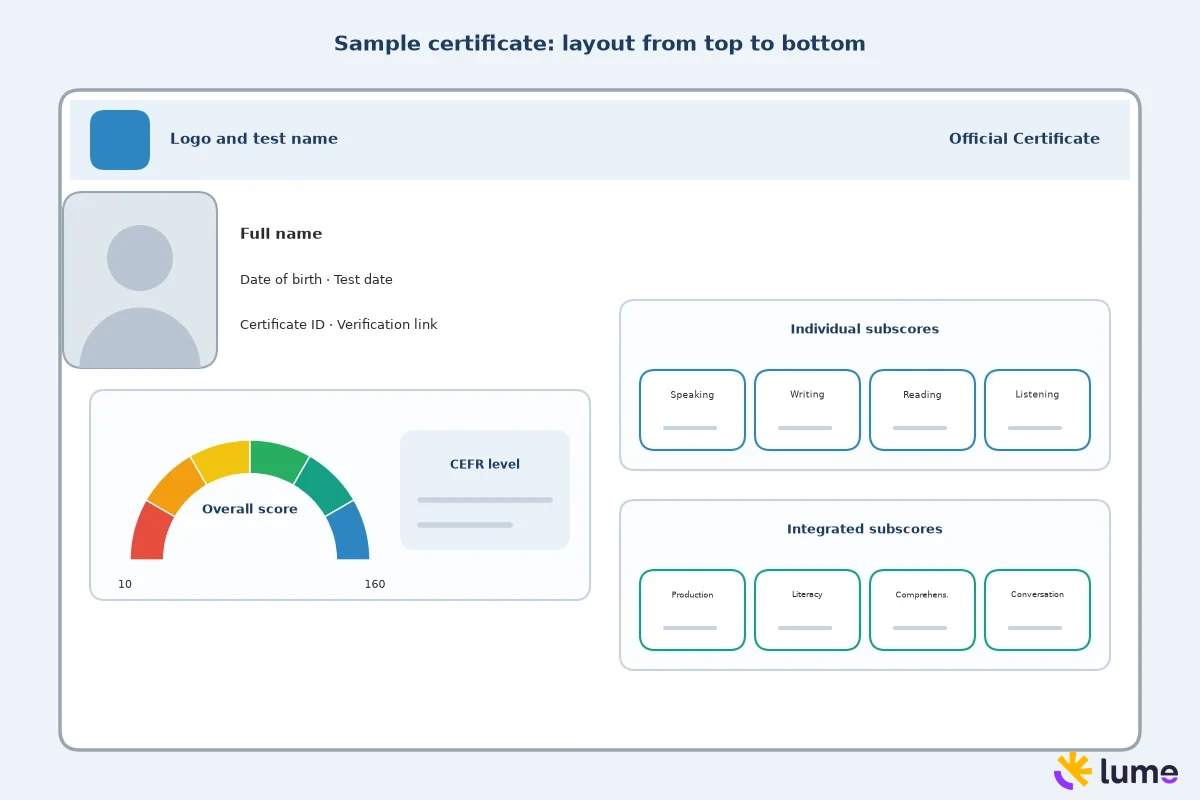
In the sample certificate illustration above, the elements run from top to bottom as follows. Your own certificate may look slightly different:
- The header: On the left side is a Duolingo logo with the “Duolingo English Test” text.
The right side includes “Official Certificate.”
- Personal information: In the sample, this box shows the candidate’s photo, full name, date of birth, test date, certificate ID, and a verification link.
The verification link is meant to let institutions check that the result is genuine.
- The overall score: You’ll find a color-coded graphic that displays your score on a scale from 10 to 160.
On the right is a conversion to the equivalent CEFR score, followed by a detailed interpretation of your language abilities.
- Individual subscores: This part presents your scores on the Speaking, Writing, Reading, and Listening sections.
- Integrated subscores: This element shows your scores on Production, Literacy, Comprehension, and Conversation.
Now, let’s break down each score element!
The Overall Score
The overall score falls somewhere between 10 (minimum score) and 160 (maximum score).
It is the average of four individual subscores, rounded to the nearest multiple of 5.
It’s because the total score scales up by 5 points at a time.
This section also displays and interprets your English level in CEFR. Duolingo’s CEFR alignment study (October 2024) confirms the score ranges for B1 to C2 below. Scores under 60 are below B1, and Duolingo’s study does not give an exact range for the A1 to A2 levels. The level names and descriptions are the ones commonly shown on certificates:
A1 to A2 (below 60): Basic
- Grasp common phrases and language related to everyday essentials, such as personal details and workplace basics.
- Capable of handling straightforward, repetitive tasks that involve exchanging information on well-known topics.
- Able to provide basic summaries of personal stories, surroundings, and urgent practical requirements.
B1 (60-95): Intermediate
- Understand core points of standard language on routine matters in school, work, leisure, etc.
- Write straightforward, connected text and descriptions on familiar themes.
- Share personal experiences and future goals, briefly justifying plans or views.
B2 (100-125): Upper Intermediate
- Comprehend complex, abstract, and technical topics within the candidate’s field.
- Interact fluently and spontaneously with native speakers.
- Draft detailed content by synthesizing and evaluating diverse sources.
C1 (130-150): Advanced
- Comprehend lengthy, demanding texts and grasp implicit meanings.
- Communicate fluently, spontaneously, and adapt language for any context.
- Produce clear, well-structured text on complex topics using precise cohesive devices.
C2 (155-160): Proficient
- Comprehend virtually any text, from abstract literature to complex technical writing.
- Synthesize diverse oral and written sources into coherent arguments.
- Communicate fluently and precisely, capturing subtle nuances in complex contexts.
The Individual Subscores
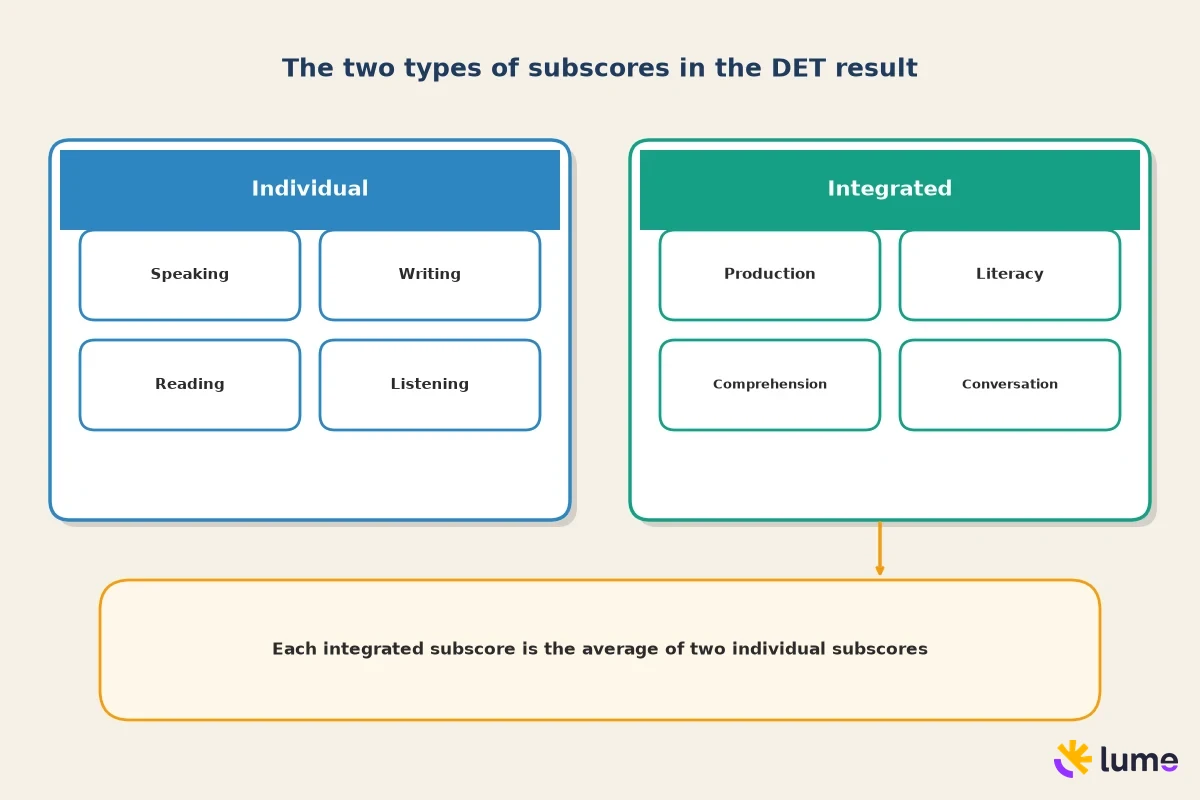
The individual subscores tell you the specific score for each skill, including Speaking, Writing, Listening, and Reading.
Like the overall score, these subscores range from 10 to 160.
Understanding them allows you to identify which skills need to improve.
The Integrated Subscores
As the name implies, integrated subscores are combined scores for two skills.
They reflect how test-takers apply multiple skills simultaneously in real-life scenarios.
There are four integrated subscores in the Duolingo English Test (DET) result:
- Production: This subscore evaluates your ability to write and speak.
- Literacy: This subscore measures your ability to read and write.
- Comprehension: This subscore assesses your ability to listen and read.
- Conversation: This subscore gauges your ability to speak and listen.
Integrated subscores are calculated using individual scores:
- First, measure the average of two individual subscores in each element.
- Then, round the number to the nearest multiple of 5.
For example, suppose your speaking and writing scores are 120 and 135, respectively.
In this case, your Production score will be 130.
Understanding the test result helps you perform better next time. Image source: Pexels
FAQs
Why Are There Two Subscore Sections?
In fact, the Duolingo English Test (DET) scorecard only included integrated subscores before.
However, since 2024, Duolingo has decided to add the individual subscores.
It’s because many universities want more detailed scores in the four skills.
So, they can easily compare or converse in other English tests like TOEFL or IELTS.
How Long Does It Take To Get The Score Result?
Typically, test-takers will receive the Duolingo English Test (DET) result within 48 hours.
However, if you book a faster result ($39, which Duolingo says it typically costs), you only have to wait for 12 hours.
Once the result is ready, Duolingo will send you a notification email, so you can check the scorecard immediately.
How Long Is The Duolingo English Test (DET) Score Valid?
The Duolingo English Test (DET) result will stay valid for two years from the test date.
After that, you have to take a new test to get a new score.
Conclusion
It’s exciting to open the Duolingo English Test (DET) scorecard.
But don’t forget to spend some time reading the certificate and reviewing your subscores carefully.
This allows you to determine your weaknesses and motivates you to perform better the next time.
We hope the Duolingo English Test (DET) result sample above can help you interpret your scores with ease!
Read this article in another language
Related practice resources
- Duolingo English Test Vocabulary List: 500+ Essential Words
- Duolingo English Test (DET) Writing Sample Questions
- Duolingo English Test Cheat Sheet: Tips, Templates, Strategy
|
Want to ACE the Duolingo English Test (DET) And Reach Your Goals? Get Your FREE Lume Account Today to Unlock… ✅ 10,000+ PRACTICE QUESTIONS with detailed answers ✅ FREE MOCK TESTS with fast & accurate AI scoring ✅ Get BETTER SCORES with a PERSONALIZED study plan (Limited seats available!) |
Share:


Lume Test
Editor
Passionate about helping learners master English exams with AI-driven insights and structured learning paths.
Practice Duolingo English Test with Lume
AI-powered scoring, realistic mock tests, and smart feedback tailored to your target score.